
Cistus Essence Spain
The use of cistus extracts in perfumery has flourished over the years and has become an emblematic ingredient, particularly for its warm, ambery and resinous scent, which creates a constant intensity.
Cistus essence has a similar olfactory character to the essential oil, with an ambery and leathery dimension, with more texture and volume, and a softer aromatic freshness in the top notes. The whole is nuanced by a subtle spicy note, smoky mineral powder notes and a honeyed, syrupy side.
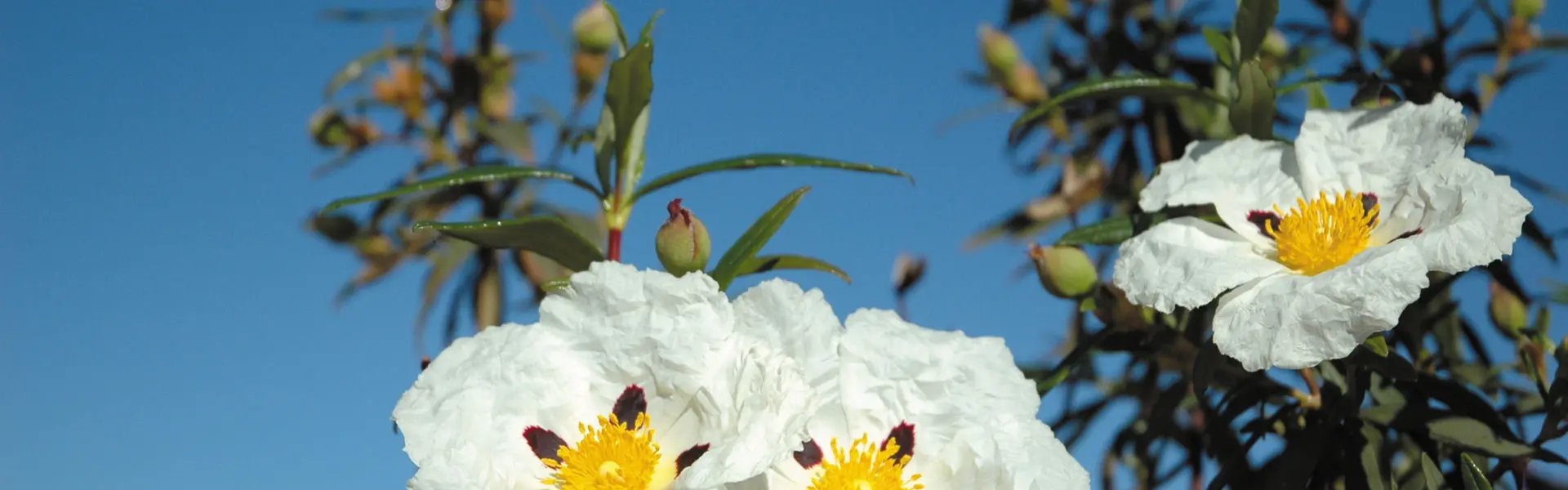
Cistus labaniferus is a shrub with a thick sap called labdanum. It blooms from April to June in the form of large white flowers with fleeting purple macules. When the flowers fade, between May and June, new branches appear. The secretive hairs on these young branches begin to produce resin.
Manual pruning of the branches begins in July when they are full of resin. Only the shoots of the year are harvested. Once cut, the branches are gathered in bundles of 25 kg and taken to the processing plant.
To obtain the cistus essence, the branches are first distilled to obtain the essential oil. The distillation also produces a second product, the distillation water, which contains fragrant molecules. The distillation water is then extracted with a solvent to recover what was left of the fragrant content in the water. Finally, the essential oil and the extract of the distillation water are blended in a specific ratio to obtain the cistus essence with an olfactory profile more ambery and leathery than the essential oil alone.
Perched on the branches of the shrub, the flowers have deep red-purple spots called ‘tears of Christ’ at the base of each of the five white petals. Unlike the highly fragrant resin, the cistus flower has no scent.
Have questions or need assistance? Our team is ready to provide you with the support you need. Click the button below to reach out, and let’s start a conversation!
Get in touch