
Cistus Oil Spain
The use of cistus extracts in perfumery has flourished over the years and has become an emblematic ingredient, particularly for its warm, ambery and resinous scent, which creates a constant intensity.
Cistus essential oil develops a rising freshness in the top with sweet and aromatic notes of artemisia. It has the characteristic personality of the cistus which brings back to the hot climate of Andalusia, with an ambered and leathery dimension.
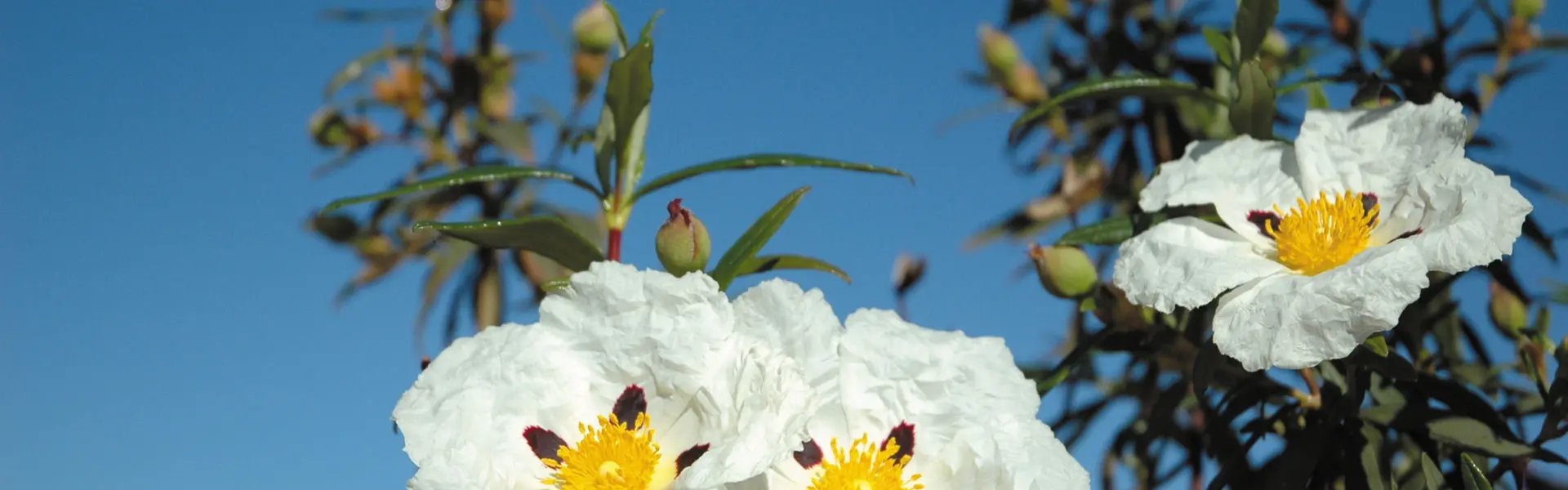
Cistus labaniferus is a shrub with a thick sap called labdanum. It blooms from April to June in the form of large white flowers with fleeting purple macules. When the flowers fade, between May and June, new branches appear. The secretive hairs on these young branches begin to produce resin.
Manual pruning of the branches begins in July when they are full of resin. Only the shoots of the year are harvested. Once cut, the branches are gathered in bundles of 25 kg and taken to the processing plant. For a good yield, good weather conditions are essential: if it rains too much during the harvesting period, the plant’s resin is ‘washed away’; if it does not rain and the air is too dry, the cistus suffers from water stress, loses some of its leaves and produces less resin.
Cistus essential oil is obtained by steam distillation of the twigs.
Perched on the branches of the shrub, the flowers have deep red-purple spots called ‘tears of Christ’ at the base of each of the five white petals. Unlike the highly fragrant resin, the cistus flower has no scent.
Have questions or need assistance? Our team is ready to provide you with the support you need. Click the button below to reach out, and let’s start a conversation!
Get in touch